Sulfonyl Hydrazides7 min read
Chemoselectivity: The Radicals Are Innocent!
October 19, 2026· Knight Chem
hydrazidesradical
Ask an organic chemist to perform a reaction in the presence of a free alcohol, phenol, carboxylic acid, or carbonyl group, and their first instinct will often be “protect it!”
There is a good reason for that.
In conventional polar chemistry, acids and bases react with each other, nucleophiles attack carbonyls, and electrophiles get quenched by unintended nucleophilic sites. As a result, much of synthetic planning involves temporarily masking and unmasking functional groups and additional considerations around protecting group orthogonality. And the synthesis becomes less and less intuitive.
Yet, as many of you have probably noticed, radical cross-coupling reactions are changing this landscape. Free alcohols, phenols, carboxylic acids, and carbonyl groups can often survive while powerful bond-forming reactions take place. Such remarkable chemoselectivity is becoming increasingly appreciated, but there is a deeper story behind why it works…
At Knight Chemicals, we specialize in bringing innovative radical cross-coupling reagents into the hands of synthetic chemists.
Why are radicals so remarkably tolerant of functional groups?
1. A carbon radical has a different personality
Let's consider three major reactive carbon species commonly involved in bond formation: a carbocation, a carbanion, and a carbon radical. (Sorry, carbenes, we'll talk about you another time!)
A carbocation carries a positive charge, while a carbanion carries a negative charge. The consequence? Polar interactions! Opposite charges attract, leading to reactions between electrophilic and nucleophilic sites. This is why reactions involving carbocations often require protection of unintended nucleophilic sites, while those involving carbanions face the opposite problem.
Meanwhile, a carbon radical is charge-neutral (well, radicals have polarities too, but let’s keep the story simple). Unlike its charged counterparts, carbon radials largely avoid the polar interactions that organic chemists intuitively worry about. This is why radical chemoselectivity can be nearly orthogonal to conventional polar chemistry. Here is a small list of functional groups that carbon radicals do not react with (1).
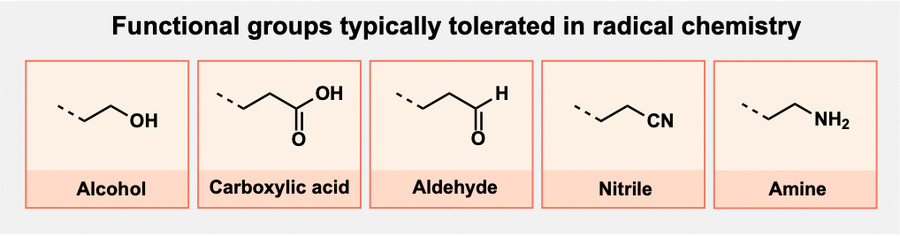
Basically, pretty much everything that we were taught to protect can be tolerated. It may look surprising, but once you think about their electronic nature, it all makes sense.
And that raises an intriguing question…
2. If the radicals are so tolerant, why aren't the reactions tolerant too?
If a carbon radical can coexist with water, alcohols, and carboxylic acids, shouldn't virtually every radical cross-coupling reaction tolerate these groups? Clearly, that's not what we see in the literature. Some radical coupling reactions work beautifully with unprotected substrates. Others still heavily rely on protecting groups.
Why? Because the carbon radical is only one player in the reaction.
The radical precursor (and its preparation) or coupling partner may actually be the one setting the chemoselectivity limit!
Before a radical can form a bond, it must be generated, and radical precursors are typically electrophiles or nucleophiles. Take a look at the common radical precursors listed below (2). Many are perfectly legitimate electrophiles or nucleophiles, meaning that the familiar chemoselectivity constraints of polar chemistry can sneak right back in!
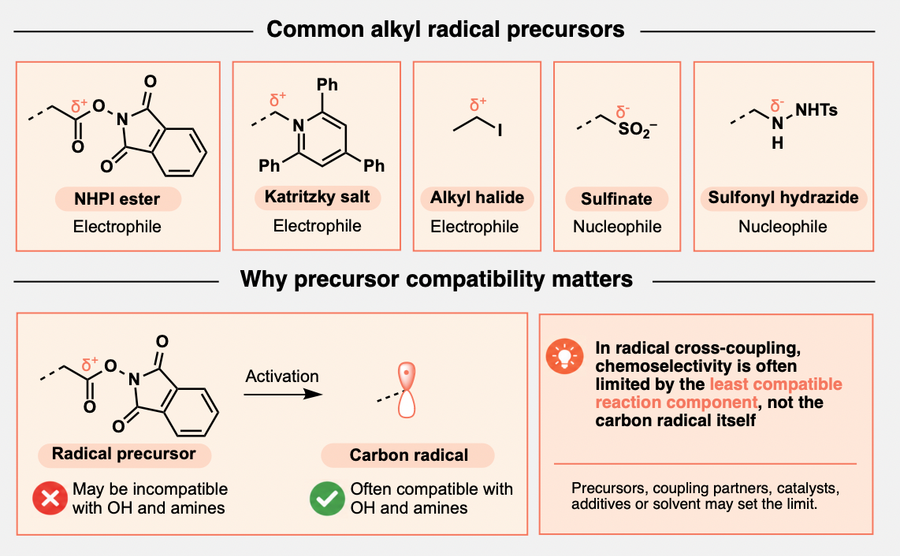
In other words, the radical may be perfectly happy to coexist with a functional group, but its own precursor might not.
And that's not all. The radical acceptor, catalyst, additives, and solvent can introduce additional constraints.
Thus, the functional-group tolerance of a radical cross-coupling reaction is not determined solely by the intrinsic reactivity of a carbon radical. It reflects the compatibility of the entire reaction system.
This leads to an interesting conclusion: the chemoselectivity we observe in radical cross-coupling may not reflect the full potential of what carbon radicals themselves are capable of.
Progress toward more compatible radical precursors
So, here's something to think about: which radical precursor is least likely to interfere with the other functional groups in a molecule? If we can expand the functional-group tolerance of the radical precursory, the functional-group tolerance of the overall radical cross-coupling will increase as well.
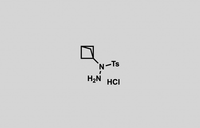
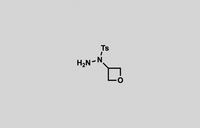
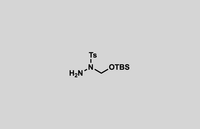
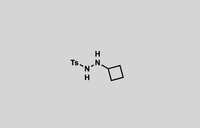
One example is the emerging use of sulfonyl hydrazides for radical cross-coupling.
Unlike highly activated electrophilic precursors, sulfonyl hydrazides are mild nucleophiles and can coexist with a variety of unprotected functional groups, including free alcohols, carboxylic acids, and carbonyl groups. Their use in redox-neutral radical cross-coupling can therefore offer an unusually attractive chemoselectivity profile (2,3).
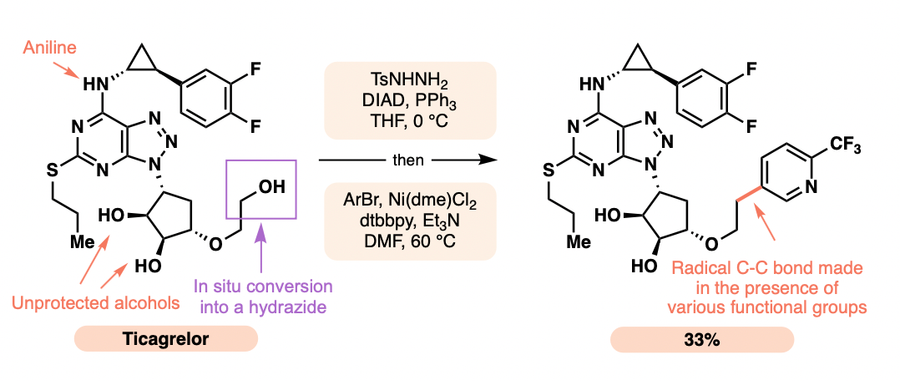
This is one reason why we at Knight Chemicals are particularly interested in commercializing sulfonyl hydrazides and making them more accessible and practical for synthetic chemists.
The take-home message
Radical chemistry is often praised for its remarkable functional-group tolerance. The source of that tolerance is inherent to the carbon radical, but limited by the radical precursor.
The compatibility of carbon radicals with many polar functional groups is a fundamental advantage. Yet the full potential of that advantage is often constrained by the closed-shell reagents and catalysts needed to generate and capture those radicals.
Certain motifs such as nitro groups, basic amines, and strongly acidic functionalities remain challenging in many cross-coupling systems, despite the impressive functional-group tolerance of modern radical reactions.
But because carbon radicals themselves can coexist with these functional groups, there may still be plenty of room to expand what radical cross-coupling can tolerate. and perhaps we haven't yet seen the full potential of radical chemoselectivity.
We’re certainly looking forward to seeing what new examples emerge in future studies in this area.
References
(1) Smith, J. M.; Harwood, S. J.; Baran, P. S. Radical Retrosynthesis. Accounts Chem Res 2018, 51 (8), 1807–1817. https://doi.org/10.1021/acs.accounts.8b00209
(2) Sun, J.; Péter, Á.; He, J.; Tsien, J.; Zhang, H.; Cagan, D. A.; Vokits, B. P.; Peters, D. S.; Oderinde, M. S.; Mandler, M. D.; Richardson, P.; Chen, D.; Palkowitz, M. D.; Raheja, N.; Kawamata, Y.; Baran, P. S. Sulfonyl Hydrazides as a General Redox-Neutral Platform for Radical Cross-Coupling. Science 2025, 387 (6741), 1377–1383. https://doi.org/10.1126/science.adu6406
(3) Neigenfind, P.; Kawamata, Y.; Baran, P. S. Simplifying Radical Cross-Coupling by Deleting Redox. 2026. https://doi.org/10.26434/chemrxiv.15007498/v1
READY TO SOURCE THESE BUILDING BLOCKS?